


A sense of feeling of anticipation. Visible is the chilled vapour emanating from my fellow runners as they do the "starting line" shuffle on the beginning point.
A quick flick of the hips.
I'm at my local weekly parkrun event and I'm focused. The countdown begins...
Wait a second. I need to sort my watch. As does the runner next to me.
The person in the line expresses impatience. I'm not moving until… done! Connection established, I'm off.
In the mele, it's difficult to find a arm without a smartwatch on it. And it's not just us runners who use them.
It's a booming, multi-billion dollar industry. Names like Apple Watch are prevalent, all offering an extensive array of diverse models to fit a variety of lifestyles. Based on how feature-packed the model you go for, prices can range from a hundred pounds to a significant investment.
"I find it infuriating, I can't stop checking."
"It reassures me… It acts as a supporter encouraging me."
"Stop telling me I've had a restless night."
A small sample of the reactions people have shared from like-minded tracker enthusiasts when I question what they feel about theirs.
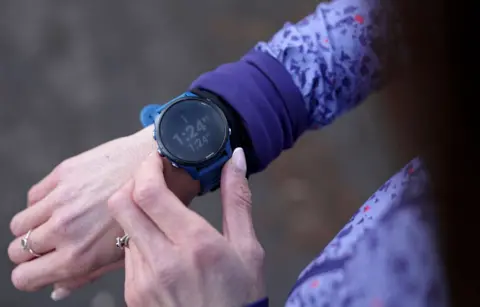
The Monitoring Conundrum
My thoughts on my own device? At this moment, annoying. It's reporting my speed is wrong, making me wonder whether the foliage I'm running below are interfering with my location tracking.
Millions of us fasten these little devices onto our arms and wear them all day and night, seemingly comfortable with the fact they're perpetually tracking us.
Gone are the days when we depended on them solely to give us an idea of our daily steps. Currently, they can analyse our sleep quality, stress levels, oxygen saturation, our VO2 max.
It's difficult to find a physical metric they aren't designed to measure.
But do they do what they claim to do? And are the statistics we analyse a faithful picture of reality? Do they boost our daily wellness, or do the avalanche of metrics and cheerleading alerts just add to our daily stresses?

Addiction or Aid?
"I do get a a little preoccupied with mine," one user reveals.
While she values how her device tracks her runs, she finds some of its other features "overwhelming" at times - a feeling first discovered during a pregnancy.
Prior to discovering she could put it into a specific mode, her smartwatch constantly alerted her she was being insufficiently productive enough. Now, the watch frequently reports her she's had a bad night's sleep.
"I have a young baby, there's no point to be informed I've not slept," she says. "I'm acutely aware perfectly well."
Couldn't she just stop wearing it?
"It's possible, perhaps, but I have this complicated dynamic with it," she continues. "I appreciate it for its workout tracking, I sometimes question whether the myriad other functions it can now do is possibly excessive for me."
How Do They Work?
Each model of smartwatch has its own novel way of monitoring your bodily functions and analysing your data, but the vast bulk use detectors on the reverse of the watch.
They typically project tiny, coloured LED lights onto your wrist which can detect pulsation, detecting your heartbeat. Sophisticated devices detect changes in the skin conductance that runs through the skin to get an idea of your stress levels.
The Professional Viewpoint
A professor says that in general for smartwatches, it's a "fine balance" - while the rapidly advancing tech could potentially prevent illness, "detecting disease before we feel unwell", it could also turn us watch wearers into the "worried well".
He points out that newer wearables can perform tests like electrocardiograms (ECGs), which continuously monitor how stable the heart is. They can alert if someone is experiencing an irregular rhythm, where there is erratic impulses in the heart causing an uneven pulse.
This does not mean someone is on the verge of a heart attack, but it can give an early warning they might be more susceptible of a blood clot in the long term.
But how to make sense of these readings is complex. The expert fears that as additional features are introduced, people may find it hard to fully comprehend their data.
"I remain sceptical that having the capacity to monitor so much data is such a positive development," he says.
A clinical psychologist focusing on patient behaviour agrees. Her work into the influence of wearable tech on a cohort of individuals with health issues suggested a noticeable percentage of those who were given devices to monitor their heart health experienced greater stress and were "far more likely to use healthcare resources".
She identified a vicious circle with her patients - they spotted a worrying figure on their watch. They became worried. Their heart rate increased. They got more worried. They re-examined the data, and their anxiety increased again.
"When people are presented with stats about ourselves that we can't properly interpret then, understandably, we are going to become concerned," the psychologist says. "We look, we check again - it becomes a feedback loop."


